Claremont Carbon Reduction Plan
PUBLICATION DATE: February 2025
Commitment to achieving Net Zero
Claremont is committed to achieving Net Zero emissions by 2040.
Overview
As a hybrid-based consultancy whose ‘products’ are largely intellectual, our environmental impacts are relatively low. The boundary of the report includes all UK-based operations during the reporting period. Our calculations regarding energy, water and waste are based on ‘financial control’ as we are based in a co-working space and do not control the services here.
However, our company mission is to change behaviours for better living, and we only do work that contributes to social good, so we are committed to playing our part in the worldwide drive to net zero.
Wherever possible we subscribe to a core philosophy of ‘reduce, re-use, recycle, repair and re-frame’. We also recognise that the activities we undertake or manage on behalf of clients and those in our employment have an impact on the environment, and believe that it is our responsibility to minimise this impact and continually strive to better our performance.
We also commit to:
- Tracking: this is our first baseline report for the year 2024; we will revisit this annually
- Reduction: a year-on-year reduction in our emissions
- Transparency: disclosing our carbon footprint data
- Collaboration: work with sustainable and ethical companies, challenge our suppliers to actively reduce their carbon footprints, and ensure our clients are considering the environmental footprint of our work with them
Baseline Emissions Footprint
Baseline emissions are a record of the greenhouse gases that have been produced in the past and were produced prior to the introduction of any strategies to reduce emissions. Baseline emissions are the reference point against which emissions reduction can be measured.
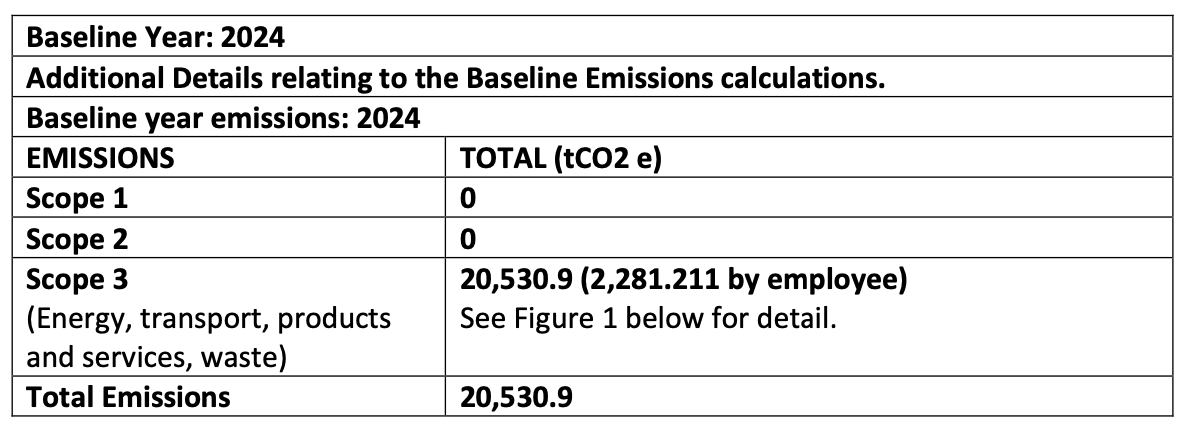
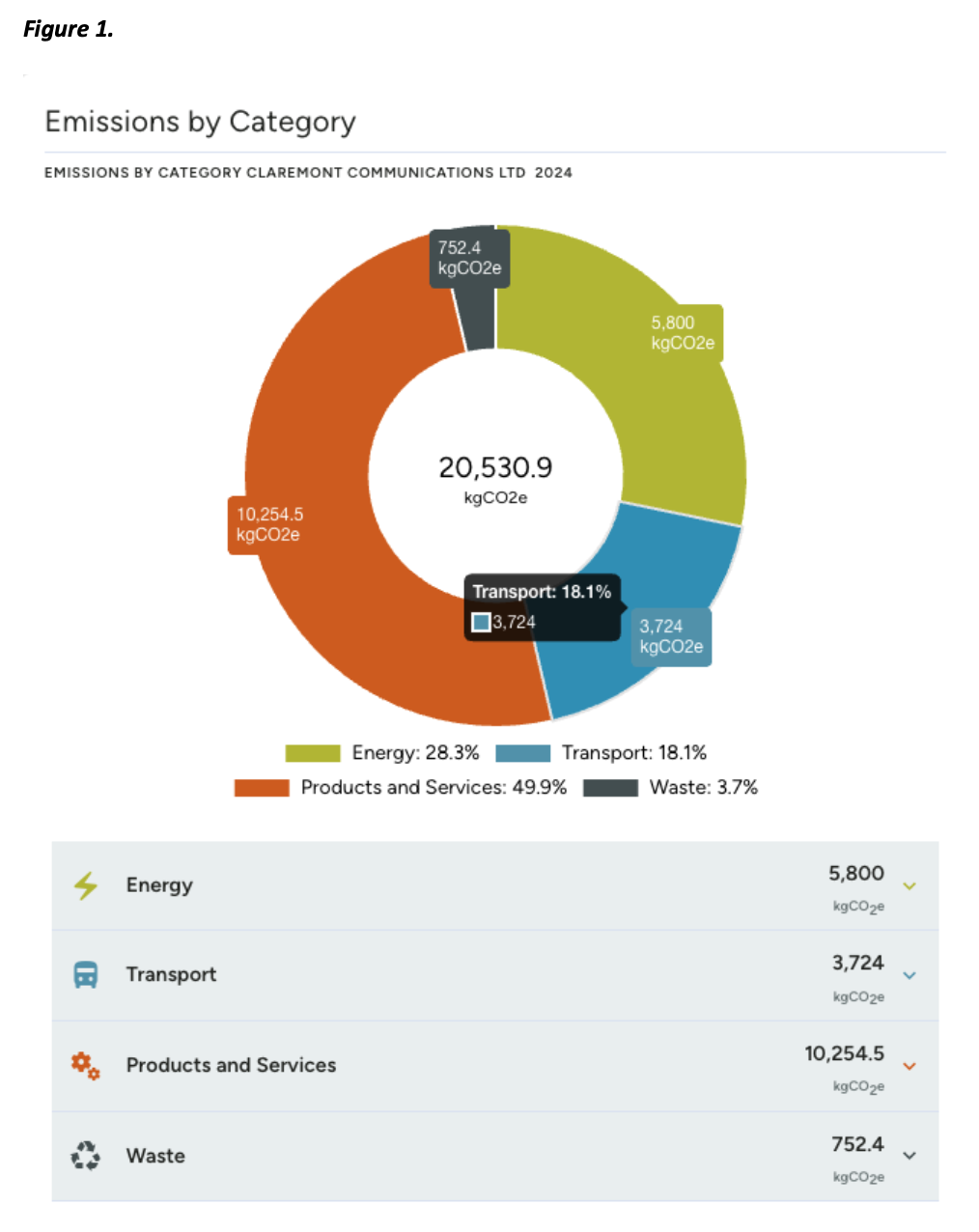
NB: Our energy, water and waste data are estimated using the Climate Essentials calculator, as our co-working space cannot provide or share data. It is based on our team being in shared offices 1 day a week on average. Business travel, employee commuting and homeworking have been calculated in Scope 3 emissions, and upstream transportation and distribution, and downstream transportation and distribution are not material to our business.
Current emissions reporting
N/A – we have only just benchmarked 2024 and have no data for 2025, so we have set a target (below).
Emissions reduction targets
To continue our progress to achieving net zero, we have adopted the following carbon reduction targets. We project that carbon emissions will decrease over the next five years to 1,800 tCO2e per employee by 2030. This is a reduction of 21%.
We cannot set an overall total carbon footprint reduction target, as we are anticipating a growth in our team, and most of our Scope 3 emissions are based on employee food and drink, homeworking and transport.
So, we have set ourselves a target of reducing carbon intensity by employee, from 2,281.211 kgCO2e to 2,050 kgCO2e during 2025 and to 1,800 kgCO2e by 2030.
Carbon Reduction Projects
Completed Carbon Reduction Initiatives
We plan to implement the following measures to reduce our carbon footprint. Please note that not all of these can be tracked via the baseline emissions data due to the nature of how the data is captured:
What can be tracked:
- Aim for food to be ‘low meat content’ (moving from medium meat content)
- Encourage staff to switch to green energy providers (increase from 60%)
- Increase proportion of journeys by bike/walking, where possible
- Keeping client meeting travel low (already drastically reduced over recent years)
What cannot currently be tracked:
- Choosing eco-friendly and sustainable suppliers for stationery and furniture
- Choosing eco-friendly and sustainable suppliers and partners for creative outputs of our work e.g. websites (e.g. low carbon web designers) and printed campaign materials
- Reducing printing and using digital copies wherever possible – we have already drastically cut down the amount that we print as a team
- Reducing food wastage as a team
- Asking staff to make use of water reduction facilities at our shared office (e.g. ensuring staff are mindful of water reduction behaviours such as dual flush toilets, only boiling the amount of water needed for hot drinks, one mug for tea/coffee in the office per day)
- Encouraging staff to avoid single use plastics e.g. water bottles and food containers.
We are also keen to better capture energy, water and waste usage from our co-working space, so will continue to pressure WeWork to provide data. Additionally, we are looking into the environmental impact of our data storage, and have introduced a supplier questionnaire to ensure that suppliers going forwards meet our standards of sustainability and ethics.
This Carbon Reduction Plan has been completed in accordance with PPN 06/21 and associated guidance and reporting standard for Carbon Reduction Plans.
Emissions have been reported and recorded in accordance with the published reporting standard for Carbon Reduction Plans and the GHG Reporting Protocol corporate standard and uses the appropriate Government emission conversion factors for greenhouse gas company reporting.
Scope 1 and Scope 2 emissions have been reported in accordance with SECR requirements (though they are not applicable to our business), and the required subset of Scope 3 emissions have been reported in accordance with the published reporting standard for Carbon Reduction Plans and the Corporate Value Chain (Scope 3) Standard.
This Carbon Reduction Plan has been reviewed and signed off by the Managing Director, Ian Fannon.