Reducing drug driving across Sussex for Sussex Police
The challenge
Drug driving is a growing and often underestimated risk on UK roads. In Sussex, police data showed that drug driving offences were rising year on year, with arrests increasingly outnumbering drink driving offences. The Christmas period presented an even sharper challenge: a time when socialising, recreational drug use and perceived enforcement gaps combine to increase risk on the roads.
Sussex Police asked Claremont to help reduce the number of people killed or seriously injured due to drug driving over the festive period. The brief was ambitious and time-bound: deliver behavioural insight, strategy, creative and a costed media plan within three months, to ensure that the campaign was live for Christmas.
Our approach
We began by building a detailed picture of the problem, combining internal police intelligence with extensive desk research. This included analysis of local arrest data, national trends, academic literature on risk-taking behaviour and a review of comparable UK and international campaigns.
Alongside this, we conducted in-depth interviews with officers working in roads policing across Sussex and Surrey, drawing on their lived experience of drug drivers: who they are, how they think and the operational realities of enforcement during the annual Christmastime policing operation.
Most crucially, we ran qualitative focus groups with people at risk of drug driving and those close to them. These anonymised sessions explored perceptions of risk, beliefs about impairment, social norms and how behaviour changes during the festive period.
Key insight
Our research revealed a consistent and challenging insight: drug drivers don’t see risk. Many believe enforcement is rare, that “everyone does it” and that their own driving ability offsets any impairment. Christmas drug drivers, in particular, see themselves as controlled and responsible – not criminals.
Traditional messages about legality or long-term consequences often failed to cut through. To be effective, the campaign needed to disrupt overconfidence, challenge normalisation and make enforcement feel immediate, visible and personal.
The strategy and creative
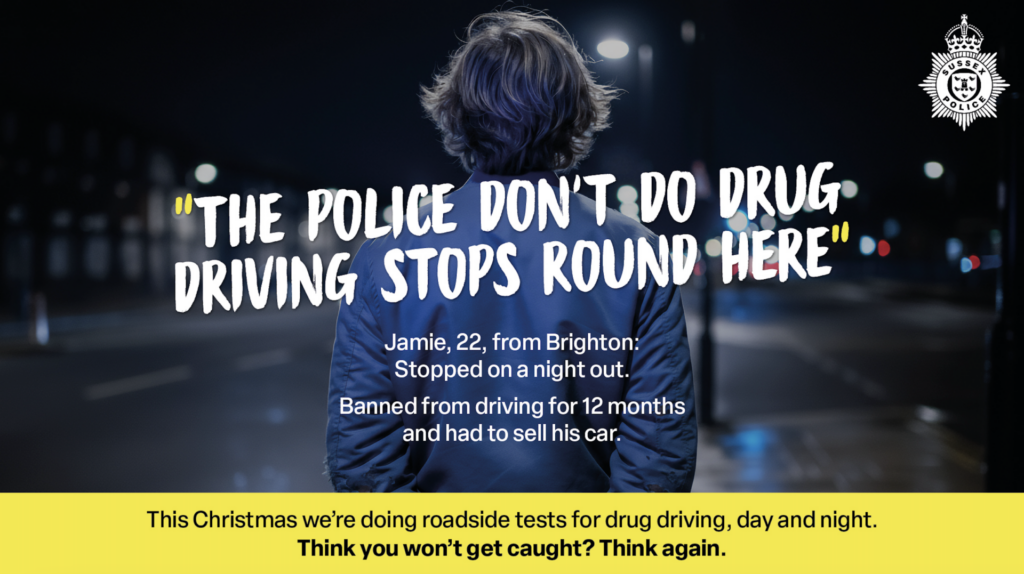
Our response was Think Again: a campaign designed to stop people in their tracks and prompt a moment of doubt. The creative used relatable characters and scenarios, in-group language and visual cues to challenge myths about safety and control.
The campaign also amplified the reality of policing activity during the period, pairing behaviour change messaging with tangible signals of enforcement.
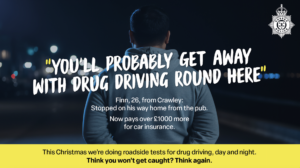
We created eight executions which aligned to the key insights from our research. We supported this with a tightly targeted, cost-effective media plan, which included digital media, petrol pump inserts and OOH. We also created a practical toolkit and hand-outs for roadside checkpoints, which officers could deploy on the ground.

Results
This work demonstrated how behaviour change principles can strengthen enforcement-led activity, even within tight timeframes and budgets. The campaign evaluation is underway, but we have already seen positive outputs including BBC News coverage and strong support from the Chief Constable and other key stakeholders.