Seeing Risk Differently: A Human Approach to Road Safety

Simon Christmas on Mar 30, 2026
Collaborator and friend of Claremont Dr Simon Christmas asks whether we need to think more broadly when we’re evaluating what we really mean by “safe”…
Is it safe? Is it risky?
Ask yourself those questions about any behaviour your work leads you to focus on and the answer will probably seem pretty obvious. But it may be worth asking yourself: safe in terms of what? Risky in what way? And what kinds of risk and safety am I forgetting about?
For example, if I ask myself those questions about ‘driving too close to the car in front’, my answers are immediate. No, it’s not safe. Yes, it’s very risky.
And because those answers are so obvious to me, when I then see other people driving too close it’s also obvious that one of three things must be going on:
- They just don’t know that they are too close
- They don’t fully understand the risks of what they’re doing
- They don’t care enough about those risks
If they did know, if they did understand the risks, if they did care… well, they’d drop back a bit, wouldn’t they? I mean, it’s obvious…
I’m a qualitative researcher, which means really trying to get under the skin of how other people experience, make sense of and find value in the world. If I’ve learned one thing from my work, it’s that the obvious is often worth questioning.
As part of a project for National Highways I recently spoke to young drivers about their experiences of keeping a safe distance on busy high-speed roads. As the project proceeded, I realised I was thinking about the space between you and the car ahead in just one way – as a safety buffer if the car in front suddenly stopped.
Which obviously it is, right?
Well yes. But also… Talking to the young drivers, I realised that that space is also someone else’s gap to move into. Which invites a complex set of questions about how drivers can and should negotiate this dual meaning. Questions on which, so far as I can see, our official guidance has absolutely nothing to offer.
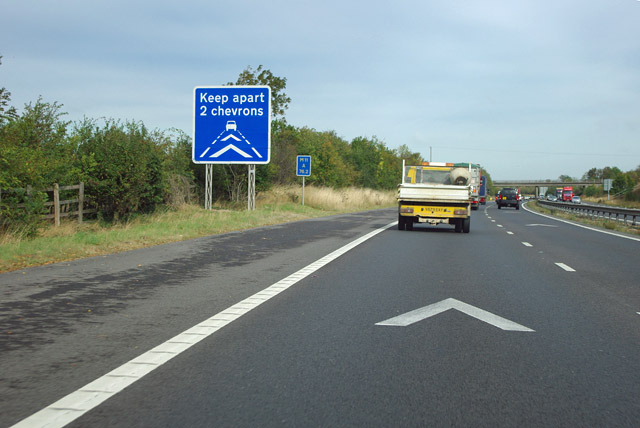
And that’s not all. That space has other meanings too. Take a look at this quotation from a participant who, between workshops, decided to give the two-second rule a go in practice.
There were chevrons and I was really keeping to them. And I was getting beeped and tailgated so much. And all my mates were in the car so it was even worse. […] I was one of the only ones keeping the space, and no one liked it. I got brake-checked, which was fun. I found that quite ironic when they were brake-checking me when I was staying well away from them. […] [My friends were saying:] “Do you want to get any further away? Can you see the sign coming up? Can you read the number plate of the lorry in front?” Stuff like that. Which is ironic because none of them can drive.
An experience likes this prompts me to ask a question I didn’t even think to ask before. Is it safe to drive too far from the car in front?
For this participant the answer might be an obvious no. And if for a moment I stop being a ‘road safety researcher’ and start thinking like a human being who drives on busy motorways, all of this suddenly seems ‘obvious’ to me as well.
When I feel threatened, unsafe, at risk, it’s not usually because I fear imminent death or injury. In such an intensely social space, negative social outcomes like shame or loss of face can be just as scary. Maybe they shouldn’t be: but hey, I’m human.
So where does this leave me.
It’s still obvious to me that driving too close to the car in front is not safe. I’m not for a second questioning the statistics or the vital importance of this issue. But I realise that, for accuracy, I need to qualify that thought.
What’s obvious to me is that driving too close to the car in front is not safe in relation to the risk of death or serious injury.
And with that in mind, those three obvious explanations of why people drive too close… well, I now see a fourth possibility that I missed: that I am not thinking about all the risks, all the ways in which one can be unsafe.
At which point, I notice that my original explanations all placed the problem – the reason for the risk – in the person. There’s something missing in them. Which may still be true… But now I’m asking if there may also be something missing in me.
If the idea of a ‘safe system’ means anything, it must surely mean always considering this possibility. Because we too are part of the system.
I do the work I do because I care about road safety. Like many in my field, I start presentations with reminders of how many people are killed and seriously injured on our roads, and how unacceptable that is.
But I also do this work because I care about people, and find them – us, me – fascinating. I care about the incredible systems we construct and operate within, how those systems can deliver great things we could never achieve on our own, but also how they can go wrong and harm us.
It’s good to focus on our little piece of that endeavour. But it’s also good to remember that it’s only a piece of a bigger picture.
 Simon is an independent social researcher who specialises in using qualitative methods to explore how people experience, make sense of and find value in the world. He’s a Senior Visiting Research Fellow at the Institute for Public Policy Research, King’s College London; an Associate Consultant at the Centre for Behaviour Change, University College London; and a member of the Research and Development Unit at UKROEd.
The research discussed in this blog was conducted with Professor Fiona Fylan, Aston Brand, and Dr Claire Williams.